
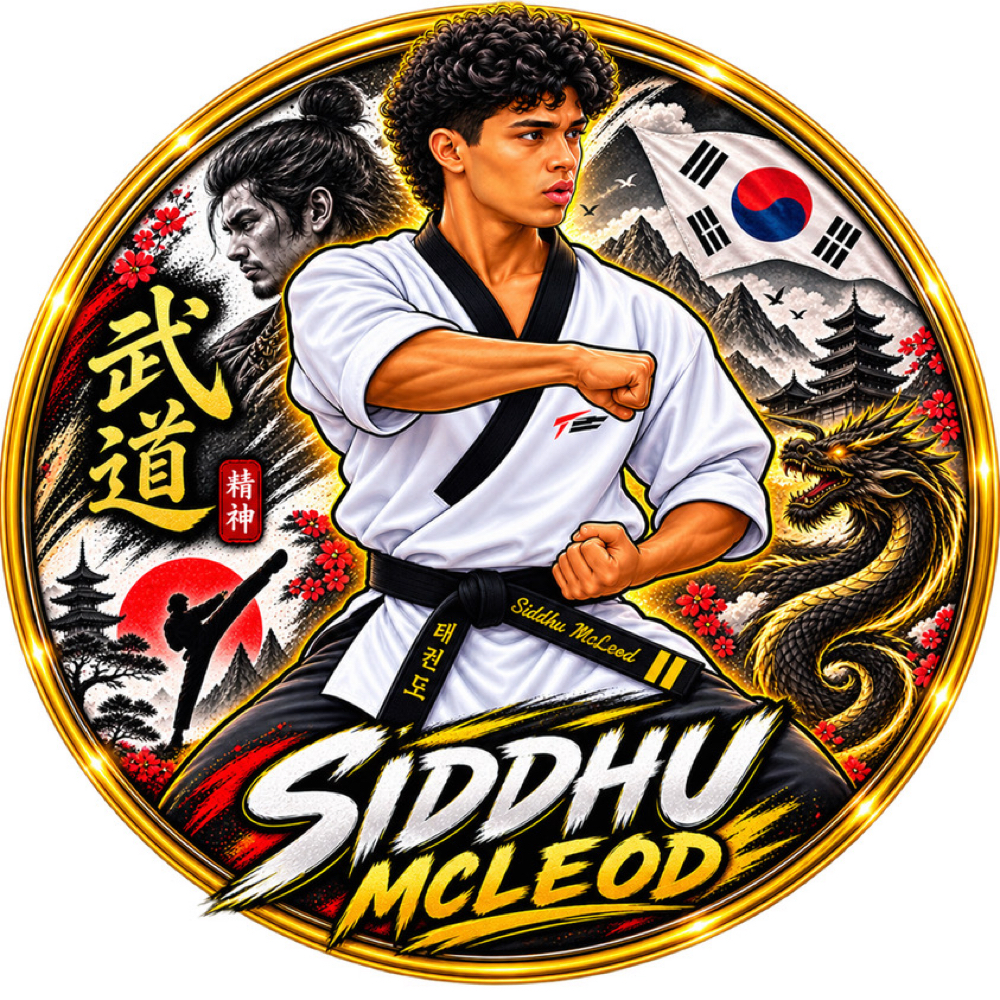
Siddhu McLeod P.S MMA interview on PFL and taekwondo

Key takeaways
- Siddhu McLeod has practiced taekwondo for roughly 14 to 15 years and holds a second-degree black belt.
- McLeod said PFL DC was his first live MMA or boxing event and that he has probably watched more PFL than UFC.
- McLeod co-hosts Three Black Belts with his brother and father to share different generational perspectives on martial arts.
- McLeod believes taekwondo’s kicks, precision and movement can be useful in MMA.
- McLeod wants to interview and train with practitioners from other martial arts, including MMA fighters and Olympians.
In the Siddhu McLeod P.S MMA interview, the second-degree taekwondo black belt told me he has probably watched more PFL than UFC since attending PFL DC, his first live MMA event. He also explained how taekwondo techniques carry into MMA and why he makes Three Black Belts videos with his brother and father.
How did Siddhu McLeod start taekwondo and Three Black Belts?
Siddhu McLeod began taekwondo at about five or six years old, after both his parents had earned black belts. Roughly 14 to 15 years later, he holds a second-degree black belt and co-hosts Three Black Belts with his brother and father to share their different perspectives on the same martial art.
Starting young and breaking boards
McLeod said he has practiced taekwondo for as long as he can remember. He fell in love with it as a child and has continued through training, teaching and, more recently, making videos about martial arts. At XL Taekwondo in Bloomington, Indiana, that work remains part of his day-to-day practice.
Board breaking is part of his promotion tests. He described stacking boards for breaks, but said he has not broken bricks. He has seen bricks broken and suggested that he might try them at a future third-degree test; he is currently a second-degree black belt.
Three generations on one channel
The Three Black Belts co-hosts practice the same style, but McLeod said each brings different priorities and a different generational perspective. Their conversations are meant to show not just techniques, but what each of them values in training. That range of views is central to what he wants the YouTube channel to communicate.
What did Siddhu McLeod say about taekwondo in MMA?
Siddhu McLeod sees taekwondo as useful in MMA because its quick kicks, hip movement and precision can work alongside techniques from other disciplines. He does not treat martial arts styles as interchangeable; his interest is in recognizing where their distinct methods connect during a fight.
He said a taekwondo practitioner watching UFC or PFL can notice familiar movements, just as someone trained in judo or jujitsu may recognize elements of their own practice. Taekwondo competition uses more protection and has its own technical demands, but he believes that does not erase the relevance of its movement to MMA.
McLeod gave the example of a quick kick and the hip movement used to shift the body while creating an attack. Describing the relationship among martial arts, he put his broader view this way:
They're all distinct, but they're all connected in some sort of way.
His interest extends beyond spotting an individual kick. When he watches a fighter, he looks at how techniques from different backgrounds can be combined, which is also why he wants to spend time training with practitioners outside taekwondo.
What did Siddhu McLeod say about PFL and PFL DC?
Siddhu McLeod attended PFL DC while he was in Washington, making it his first live MMA or boxing event. The crowd and the chance to watch fighters up close drew him toward PFL; although he does not watch fights every week, he said he has probably seen more PFL than UFC.
His first live MMA event
McLeod had only recently become aware of PFL when he went to the event. He wanted to compare what he saw with his own taekwondo practice, but the atmosphere became a story in itself. He recalled the contrast between crowd silence when a fighter was struggling and the reaction when that fighter recovered.
The setting felt different from a taekwondo tournament. He also described PFL as a more personal viewing experience, in part because he sees less promotion for it and smaller venues than he associates with UFC. Watching live gave him a way into following the promotion that he had not found before attending.
Watching PFL after Washington
One fighter whose style caught McLeod’s attention was Koshin Dibele. McLeod described him as quick, powerful and aggressive rather than hesitant, while making clear that he had not looked further into the fighter afterward. He also respected a fighter he saw remain composed despite a difficult crowd reaction.
McLeod said he had heard more about PFL on social media recently and agreed that more than one major MMA promotion can be valuable. He had not heard about a proposed PFL and MVP tie-up when I raised it. He knew of PFL Africa but had not settled on watching it or checked who was competing.
How does Siddhu McLeod approach taekwondo training and belt tests?
Siddhu McLeod’s taekwondo training combines sparring, forms, board breaking and Korean terminology. He said belt sequences vary by school, while his own black belt test included sparring against one, two and three opponents, requiring him to move and evade in ways that preserved an advantage.
Using distance in sparring
McLeod teaches students to think about reach. A taller fighter can use kicks to keep a shorter opponent at a distance; the shorter fighter needs to get inside that range. He has used kicks to maintain space against shorter opponents in tournaments and has also seen how entering close range can reverse the apparent reach advantage.
For McLeod, that is a practical lesson rather than a fixed rule about who will win. He described the need for a shorter, flexible fighter to get close enough to use techniques when an opponent can no longer comfortably extend longer-range kicks.
Forms, tests and the roots of taekwondo
His current school uses striped belts and requires forms, breaking, sparring and terminology for promotion. McLeod said his first school emphasized different forms; his current tests use Palgwe forms and, at black belt level, forms including Koryo. He also values learning Korean terms and counting in class.
At one school, he recalled seeing the U.S. and Korean flags displayed together as a sign of respect for both countries and taekwondo’s origins. He has not visited South Korea, but wants to go to Kukkiwon. Morocco and a return to Paris are also among the trips he hopes to make.
What are Siddhu McLeod’s goals for martial arts content creation?
Siddhu McLeod wants Three Black Belts to explain the physical and mental values his family finds in taekwondo. For his own work, he hopes to interview and train with people from different disciplines, including Olympians, MMA fighters and other martial artists, rather than focus mainly on fight commentary.
Todd Atkins and new connections
Todd Atkins contacted Three Black Belts and arranged an interview with the family. McLeod said their later conversations introduced him to a wider group of creators, including P.S MMA. Those introductions fit the kind of exchange McLeod wants to build through his own interviews.
Interviews and practice at the dojang
His plans include demonstrations, technique videos and inviting practitioners to train at his dojang. They do not have to come from taekwondo: he named MMA, Muay Thai and judo among the disciplines he would like to explore with collaborators.
McLeod wants to hear why martial arts matter to people with different experiences, without forcing those experiences into one universal approach. Talking with practitioners is his first priority; in-person collaboration and demonstrations would let him test those conversations against the practice itself.
What did Siddhu McLeod say about protective gear in taekwondo?
Siddhu McLeod described his taekwondo sparring as a contact-based points contest with protected targets, distinct from the MMA bouts he watches. He is curious about less-protected taekwondo and karate competitions, particularly how their rules and presentation might change the way people understand those arts.
In his account of taekwondo sparring, contact with a chest protector scores, while contact to the protected head can be worth more. Power still matters to him, but he said the scoring makes each successful contact especially clear within the match.
He has seen videos of competitions using taekwondo or karate techniques without the chest protectors and headgear he associates with his usual sparring. He did not name the organization. What interests him is whether removing that equipment changes the techniques on display or simply creates a tougher-looking version of familiar martial arts.
Who is Siddhu McLeod?
Siddhu McLeod is a second-degree taekwondo black belt and a member of Three Black Belts.
Watch the full interview
Questions from the interview
How old was Siddhu McLeod when he started taekwondo?
Siddhu McLeod said he started taekwondo at about five or six years old, after both his parents had earned black belts.
What degree black belt does Siddhu McLeod hold?
Siddhu McLeod holds a second-degree taekwondo black belt.
Has Siddhu McLeod broken bricks?
Siddhu McLeod said he breaks boards during promotion tests but has not broken bricks. He suggested he might try bricks at a future third-degree test.
Was PFL DC Siddhu McLeod’s first live MMA event?
Yes. Siddhu McLeod said PFL DC was his first live MMA or boxing event.
Has Siddhu McLeod visited Kukkiwon?
No. Siddhu McLeod said he has not visited South Korea and hopes to visit Kukkiwon one day.
Who co-hosts Three Black Belts with Siddhu McLeod?
Siddhu McLeod co-hosts Three Black Belts with his brother and father.
In this interview
More from P.S MMA

News