
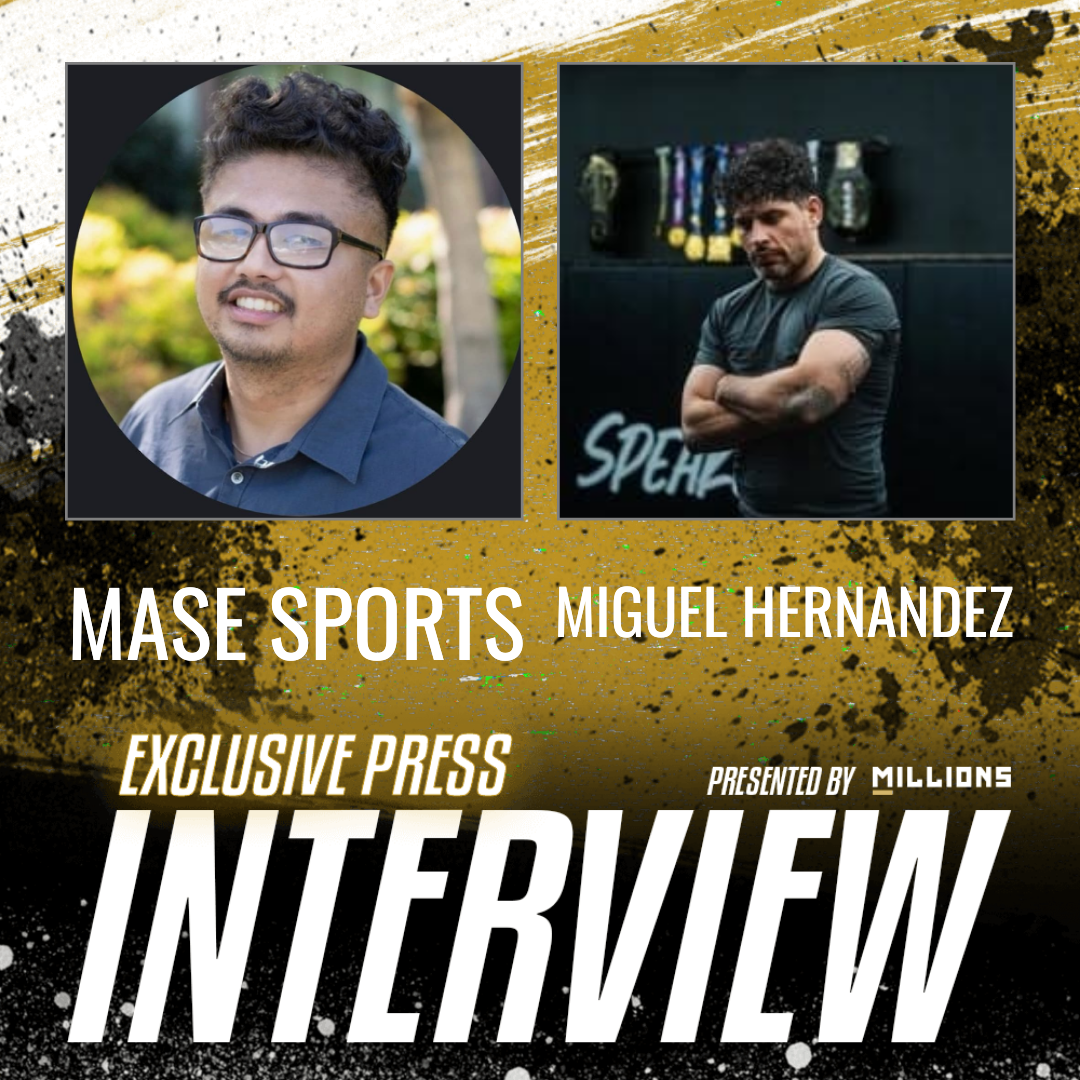
Miguel Hernandez on Jacob Pulaski and His Grappling Game Plan

Key takeaways
- Miguel Hernandez plans to face Jacob Pulaski in his seventh submission-grappling superfight.
- Hernandez said he has studied Pulaski’s matches and plans to exploit impatience and overextension.
- Hernandez said he is cutting from 195 to 185 pounds and feels in the best shape of his life.
- Hernandez coaches at Speakeasy Jiu-Jitsu and helps residents recover from Tropical Storm Helene through his social work.
- Hernandez wants to compete in ADCC and IBJJF tournaments before ending his competitive career.
Miguel Hernandez on Jacob Pulaski begins with a matchup Hernandez has followed for years. Speaking with Mase Sports ahead of their Scrap Files submission-grappling match, Hernandez said he plans to use experience and technical control against Pulaski’s athleticism. He also described an intensive training camp, his work helping North Carolina residents recover from Tropical Storm Helene, and his ambition to compete in ADCC and International Brazilian Jiu-Jitsu Federation tournaments.
What is Miguel Hernandez’s next fight, and what does he do outside competition?
Miguel Hernandez plans to face Jacob Pulaski in what he says will be his seventh submission-grappling superfight. Approaching 40, he wants more matches and experience while he can still pursue major tournaments. Competition is only part of his schedule: he coaches jiu-jitsu and works full time as a social worker.
Coaching at Speakeasy Jiu-Jitsu
Hernandez is one of the head coaches at Speakeasy Jiu-Jitsu in Ashford, North Carolina, where he trains his own athletes. He said coaching also sharpens his understanding of the sport. He has practiced jiu-jitsu for 10 years and made clear that the Pulaski match is submission grappling, not a striking contest.
Helping residents after Tropical Storm Helene
His full-time job is helping people recover from Tropical Storm Helene. Hernandez described flooding, wind and fallen trees that damaged his area, and said his role is part of the effort to help residents regain what they had before the storm.
The work has prompted conversations when he visits Puerto Rico. People there have asked why he left an island with its own hardship to help struggling residents in the United States. Hernandez acknowledged the question without presenting his work in North Carolina as a solution to Puerto Rico’s problems.
What did Miguel Hernandez say about martial arts history and cultural tattoos?
Miguel Hernandez said modern prize fighting can leave too little room for the history behind martial arts. He pointed to Japanese immigrants bringing jiu-jitsu to Brazil and to capoeira’s roots among formerly enslaved Africans. For him, studying a fighting style should also mean asking where it came from and what it meant to its practitioners.
History beyond the promotion
Hernandez distinguished the career and promotional side of MMA from the histories of its component arts. He welcomed a discussion that went beyond how athletes compete now, saying those origins are often absent when people talk about fights.
What a tattoo represents
The conversation also turned to Indigenous tattoos in the Caribbean and the Philippines. Hernandez described people reconnecting with cultural practices, while stressing that a tattoo can carry a meaning an outsider may not understand. His point was to learn what a design represents rather than treat it as decoration alone.
What did Miguel Hernandez say about Jacob Pulaski’s grappling?
Miguel Hernandez respects Jacob Pulaski’s activity and skill but believes he can capitalize when the younger grappler gets impatient and overextends. Hernandez said he has followed Pulaski since his blue-belt days, studied his matches and expects a contest between Pulaski’s athleticism and his own experience and technical control.
Following Pulaski’s rise
Hernandez recalled seeing Pulaski’s first match roughly six years earlier and watching him compete across promotions since then. He called facing someone whose career he has followed a privilege. Pulaski, he said, is young, skilled and active, and does not have boring matches. Hernandez does not view him simply as a stepping stone toward larger events.
The opening Hernandez is studying
After watching extensive footage, Hernandez identified impatience and overextension as openings he wants to exploit. He hopes to finish early, then shake Pulaski’s hand. He framed the contest as a chance to test his skills and, win or lose, take something useful from it.
Adobo and coquito after the match
Talk of a post-match meal led to a comparison of adobo, plantains and Puerto Rican coquito. Hernandez said he wanted adobo after competing and offered to share his family’s coquito recipe with Mase Sports. The exchange offered a lighter interlude before the discussion returned to scouting and preparation.
How is Miguel Hernandez training for Jacob Pulaski and handling pressure?
Miguel Hernandez said roughly two months of preparation have put him in the best shape of his life for Jacob Pulaski. His routine combines long hikes, weights and technical training. In the match, he wants to slow Pulaski down, adapt when positions change and keep his thinking steady if an exchange goes against him.
Conditioning and weight
Hernandez described 10-mile hikes in the North Carolina mountains, cardio and weightlifting in the morning, and technical work at the gym later in the day. He also teaches and coaches students. He said he can complete 12 rounds in the gym without getting exhausted and is cutting from his usual 195 pounds to 185 for the match.
Hernandez wants spectators to notice his technique rather than measure him only against Pulaski’s youth or athleticism. He gave Mase Sports his clearest statement of what he hopes to demonstrate:
my technique can overcome youth and athleticism for sure
Staying composed when a plan fails
Hernandez’s game plan is to draw Pulaski toward positions and a pace he prefers, but he expects to adjust as the match unfolds. He recalled his second loss, when an opponent escaped his attacks and he felt himself panic as the contest shifted. That experience taught him to reset instead of letting frustration drain his energy.
During match week, he tries to keep his routine normal, rest eight hours, eat well and drink water. On match day, he said he uses a sauna to get a sweat going and settle himself rather than entering with his energy too high.
How did growing up in Puerto Rico shape Miguel Hernandez’s jiu-jitsu journey?
Miguel Hernandez said he was bullied as a skinny, light-skinned child in a rough part of Puerto Rico. His father and grandfather taught him to fight and stand up for himself, but he said martial arts training as an adult was what helped him put those lessons into practice and build lasting confidence.
For Hernandez, grappling provides a controlled test of how he responds when another person applies pressure. Learning that he can stay calm, defend himself and work back from adversity matters to him beyond any single result.
That confidence does not mean taking every confrontation. Hernandez also spoke about the judgment that comes with experience: knowing when a fight is not worth having. He connected that restraint to the composure he now tries to maintain in competition.
What are Miguel Hernandez’s ADCC and IBJJF goals after Scrap Files?
Miguel Hernandez wants the Pulaski match to be another step toward competing in ADCC and International Brazilian Jiu-Jitsu Federation tournaments. He described jiu-jitsu as a continuing process of study and improvement, and said bigger events would let him test whether his skills and conditioning hold up against several strong opponents in one day.
North Carolina grapplers to watch
Asked about the local scene, Hernandez pointed beyond the established competition around Charlotte and Raleigh-Durham to Western North Carolina. He named Cameron Arrowwood and Jay Jacob Baker as promising grapplers from the Brevard area and said both were competing at the same event.
Advice for someone starting jiu-jitsu
Hernandez’s advice to beginners was to expect discomfort and accept being inexperienced for a while. New students, he said, will face unfamiliar concepts, physical contact and the experience of tapping out. He sees humility and a willingness to keep returning as essential to improving.
Who is Miguel Hernandez?
Miguel Hernandez is a Brazilian jiu-jitsu competitor focused on refining grappling techniques, mastering submissions and improving positional control through dedicated training and discipline.
Watch the full interview
Questions from the interview
How many submission-grappling superfights has Miguel Hernandez had?
Miguel Hernandez said his match against Jacob Pulaski would be his seventh superfight.
What weight is Miguel Hernandez targeting for the Pulaski match?
Miguel Hernandez said he usually weighs 195 pounds and is cutting to 185 pounds for the Jacob Pulaski match.
How long has Miguel Hernandez practiced jiu-jitsu?
Miguel Hernandez said he has practiced jiu-jitsu for 10 years.
Where does Miguel Hernandez coach jiu-jitsu?
Miguel Hernandez said he is one of the head coaches at Speakeasy Jiu-Jitsu in Ashford, North Carolina.
Which North Carolina grapplers did Miguel Hernandez recommend watching?
Miguel Hernandez named Cameron Arrowwood and Jay Jacob Baker as promising grapplers from the Brevard area.
In this interview

More from Mase Sports

News

News

News