
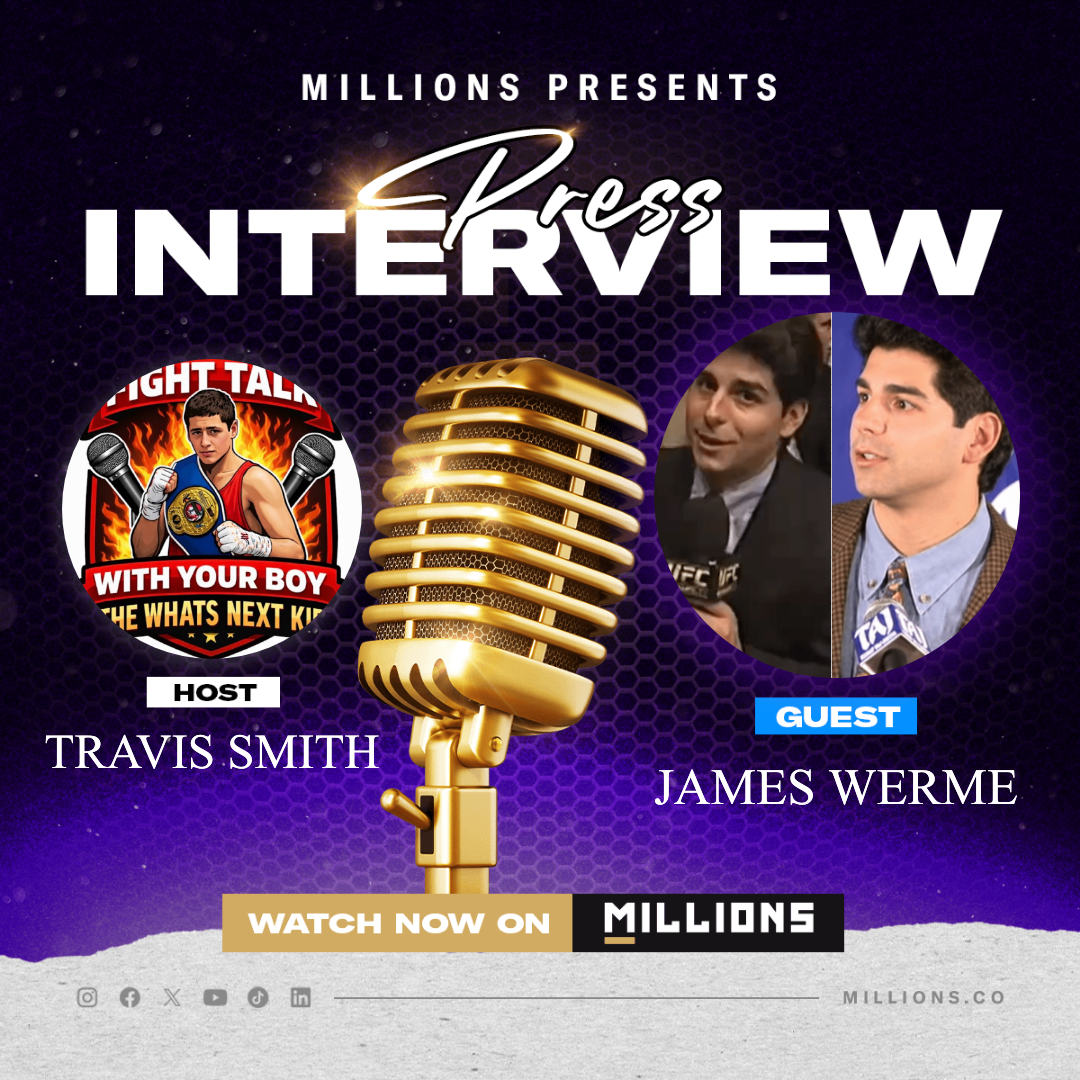
James Werme FIGHT TALK WITH YOUR BOY THE WHATS NEXT KID interview

Key takeaways
- James Werme said the UFC might have ended if its emergency relocation of UFC 12 had failed.
- Werme said the UFC 12 team went live in Dothan roughly 24 hours after leaving Niagara Falls.
- Werme said he was the only employee to move with the UFC from New York City to Las Vegas after the 2001 sale.
- Werme recalled Dana White and the Fertitta brothers discussing how they could run a boxing show better.
- Werme expected the proposed Tyson Fury–Anthony Joshua fight to proceed despite promoter disputes.
In the James Werme FIGHT TALK WITH YOUR BOY THE WHATS NEXT KID interview, Werme said UFC 12 might have been the Ultimate Fighting Championship’s last show if its emergency move from Niagara Falls to Dothan, Alabama, had failed. He also described moving with the promotion from New York City to Las Vegas after Dana White and the Fertitta brothers bought it, and recalled their early conversations about boxing.
What did James Werme say about working for the UFC in the 1990s?
James Werme said he joined the UFC in 1995 without knowing much about the show, then found himself immersed in a promotion facing political opposition while its audience grew. By 1998, he was running the show day to day; after the 2001 sale, he became Zuffa’s vice president of production.
Learning the show during the spectacle years
Werme had worked for the World Wrestling Federation in 1995, one of his first jobs after college. He was hired specifically to work on the UFC, where the scale of the production, its fighters and its public reception made an immediate impression. He called that period the show’s spectacle days.
Its popularity came with backlash, Werme said, both politically and across the industry. The production team faced new opposition and practical challenges while trying to keep putting on events. For him, the combination of those pressures and the show’s successes made the mid-to-late 1990s an unusually demanding time to work there.
Moving from New York City to Las Vegas
Werme said he was the only employee who went with the UFC from New York City to Las Vegas when Dana White and the Fertitta brothers bought it in 2001. His work had already taken him across the United States and to shows in Japan and Brazil. The move gave him a role in the promotion’s next phase rather than ending his run with its previous owner.
Why did James Werme think the UFC 12 relocation mattered so much?
James Werme said UFC 12 was a possible turning point for the promotion’s survival: if the team had failed to relocate the show from Niagara Falls to Dothan, Alabama, he believed the UFC probably would have ended that night. He only felt certain they had succeeded when the event went live.
Getting from Niagara Falls to Dothan
The move required more than finding another arena. Werme recalled relocating people, the show and the Octagon, preparing the new building, and spending the day handling press and arena work. He said the team went live as planned roughly 24 hours after leaving Niagara Falls.
At that moment, Werme turned to David Isaacs, then the chief executive of Semaphore Entertainment Group’s sports business, and registered that they had pulled it off. He described the relocation as a collective effort by people who worked together closely and understood how much depended on the broadcast.
What a missed show could have cost
Werme said the UFC was not in a financial position to lose a show’s revenue. Nor, in his view, could it afford to miss an event while maintaining its relationships with cable operators and pay-per-view providers. That is why he places UFC 12 among the most important shows in the promotion’s history, rather than treating the move only as an unusual production story.
He also connected the decision to the jobs and livelihoods of the people involved and to what they believed was the sport’s future. Werme put the team’s reasoning plainly:
we really didn't have a choice
What did James Werme say about UFC fighters of the 1990s?
James Werme said the UFC repeatedly worked with the same fighters and camps, giving its staff a close view of the athletes who shaped the promotion. Among the names he raised were Frank Shamrock, Tito Ortiz and Randy Couture; he also pointed to fighters who remained prominent as the UFC changed ownership.
The fighters Werme first named
His list included Bas Rutten, Maurice Smith, Pedro Rizzo, Matt Hughes and Jens Pulver, alongside Shamrock, Ortiz and Couture. Werme said those athletes helped both the sport and the show evolve. He remembered the camps as well as individual fighters, noting that some produced new generations of competitors.
Werme identified Ortiz as the face of the organization during the transition to Zuffa and praised Couture’s place in that period. He also brought up Vitor Belfort and Josh Barnett. BJ Penn belonged in the wider discussion, he said, although Penn came later than some of the late-1990s names he had initially been recalling.
More names from Werme’s UFC years
As he continued thinking through the roster, Werme mentioned Tsuyoshi Kohsaka, Guy Mezger, Jerry Bohlander, Mark Coleman, Kevin Randleman, Pat Miletich and Jeremy Horn. He remembered losing some heavyweights to the Pride organization, while saying Randleman stayed with the UFC and held its belt for a time.
His recollection was less a ranking than a picture of how familiar the fighters and camps had become to the people running the events. Werme said their fights were still being discussed long after those shows.
What did James Werme say about Dana White and boxing?
James Werme said Dana White’s move into boxing did not surprise him. When White and the Fertitta brothers bought the UFC, Werme recalled conversations about boxing’s problems and their belief that they could run a boxing show better. He also expected resistance from established figures in the sport.
The boxing conversations after the UFC sale
According to Werme, White and the Fertittas were boxing fans before they became UFC fans. He recalled Lorenzo Fertitta telling him that, when Lorenzo was young, boxing served as a professional sport for his family to follow in Las Vegas before the city had professional sports teams.
Werme also pointed to Lorenzo Fertitta’s time on the Nevada State Athletic Commission and to White’s background in training and amateur boxing. After decades running a fight promotion, he said, their interest in putting on boxing events followed naturally from those earlier conversations.
That interest did not mean an easy reception. Werme said he was unsurprised by the friction and pushback around White’s boxing involvement, even as he understood why White and the Fertittas would want to enter the business.
What did James Werme say about Tyson Fury, Anthony Joshua and promoter disputes?
James Werme expected the proposed Tyson Fury–Anthony Joshua fight to go ahead despite the promoter dispute being discussed at the time. He viewed the argument over Dana White’s involvement as fight-promotion politics, but thought too much work and money were attached to the event for that disagreement to derail it.
The dispute over Dana White’s presence
Werme said each side could see the situation differently. From Eddie’s perspective, he suggested, White might appear to be pushing into another promoter’s event. Werme nevertheless did not want a dispute between promoters to cancel or affect a fight that people had waited to see.
His expectation was a prediction at the time, not an account of what later happened. Werme said he thought the promotion was moving forward, while acknowledging that who attended and what was said before the fight remained uncertain.
Madison Square Garden and an English audience
When the conversation turned to Madison Square Garden, Werme said a New York event would appeal to local fans and anyone able to afford a ticket. For television viewers, he argued, the venue mattered much less.
He gave more weight to the English audience. With two leading English fighters involved, Werme said there was a case for staging the fight in England. His point was not that New York lacked appeal, but that the location had different significance for people buying tickets and people watching from elsewhere.
Who is James Werme?
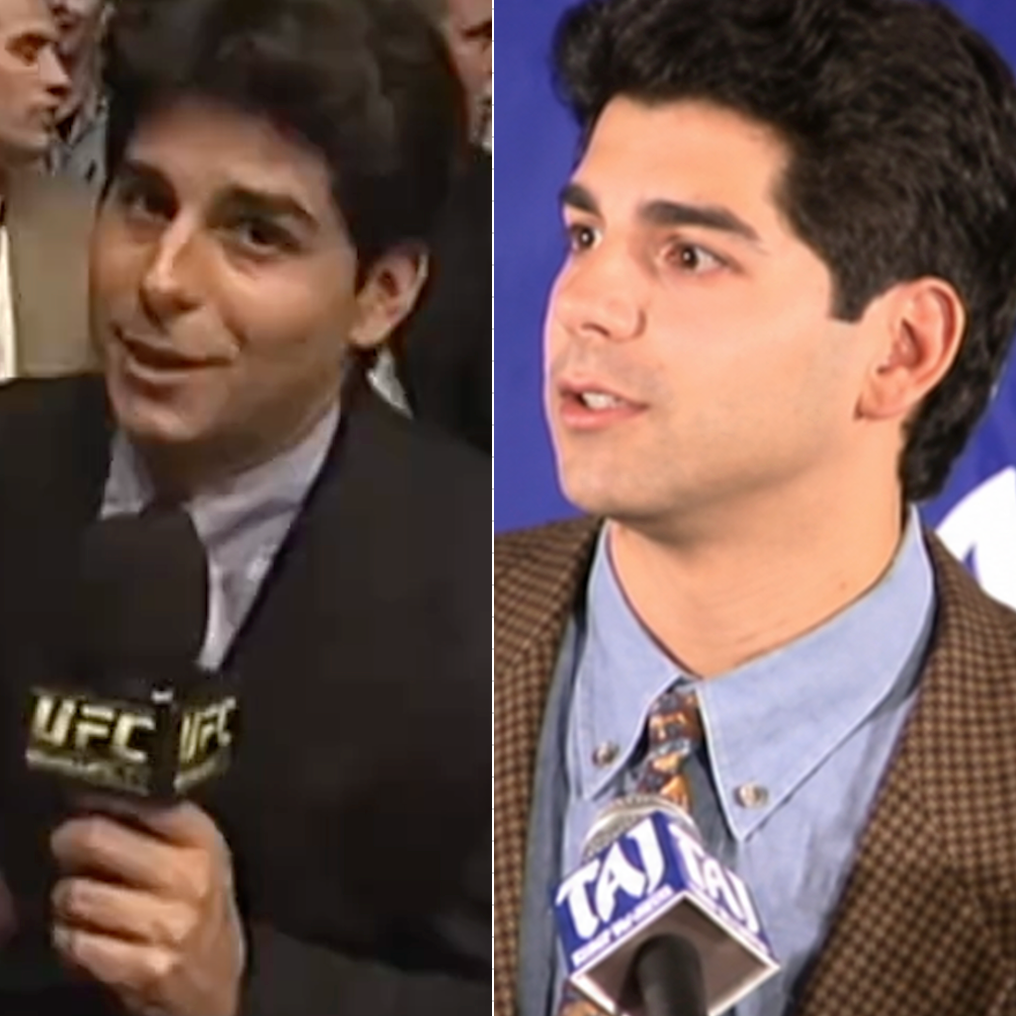
James Werme is a former UFC producer and on-air announcer who worked on 40 UFC events from 1995 to 2002. He was the show’s lead executive and producer from 1998 to 2001, announced on air from 1999 to 2001, and worked for both Semaphore Entertainment Group and Zuffa.
Werme was the only employee to move with the show from New York City to Las Vegas in 2001. As Zuffa’s vice president of production, he produced its first six UFC shows. He had also worked for the World Wrestling Federation in 1995.
Watch the full interview
Questions from the interview
How long did James Werme work for the UFC?
James Werme worked on the UFC from 1995 to 2002 and produced 40 UFC events during that period.
How quickly did the UFC 12 team relocate the show?
James Werme said the UFC 12 team went live in Dothan, Alabama, roughly 24 hours after leaving Niagara Falls.
Did James Werme move to Las Vegas with the UFC?
Yes. James Werme said he was the only employee who moved with the UFC from New York City to Las Vegas after its 2001 sale.
Which fighters did James Werme call important to the UFC’s early years?
James Werme named Frank Shamrock, Tito Ortiz and Randy Couture among the notable fighters from his UFC years. He also discussed Bas Rutten, Maurice Smith, Pedro Rizzo and others.
Why was James Werme unsurprised by Dana White’s interest in boxing?
James Werme recalled Dana White and the Fertitta brothers discussing boxing when they bought the UFC, including their belief that they could run a boxing show better.
Did James Werme think the Tyson Fury–Anthony Joshua fight would happen?
James Werme expected the proposed Tyson Fury–Anthony Joshua fight to go ahead despite the promoter dispute being discussed at the time.
In this interview

More from FIGHT TALK WITH YOUR BOY THE WHATS NEXT KID
News
Chase Daudelin FIGHT TALK WITH YOUR BOY THE WHATS...
FIGHT TALK WITH YOUR BOY THE WHATS NEXT KID
6 Oct 2026 at 12:04 AM
News
Samuel Norris FIGHT TALK WITH YOUR BOY THE WHATS...
FIGHT TALK WITH YOUR BOY THE WHATS NEXT KID
5 Oct 2026 at 10:53 PM

News
Austin "No limit" Conrad on Jordan Krifka and...
FIGHT TALK WITH YOUR BOY THE WHATS NEXT KID
5 Oct 2026 at 09:05 PM